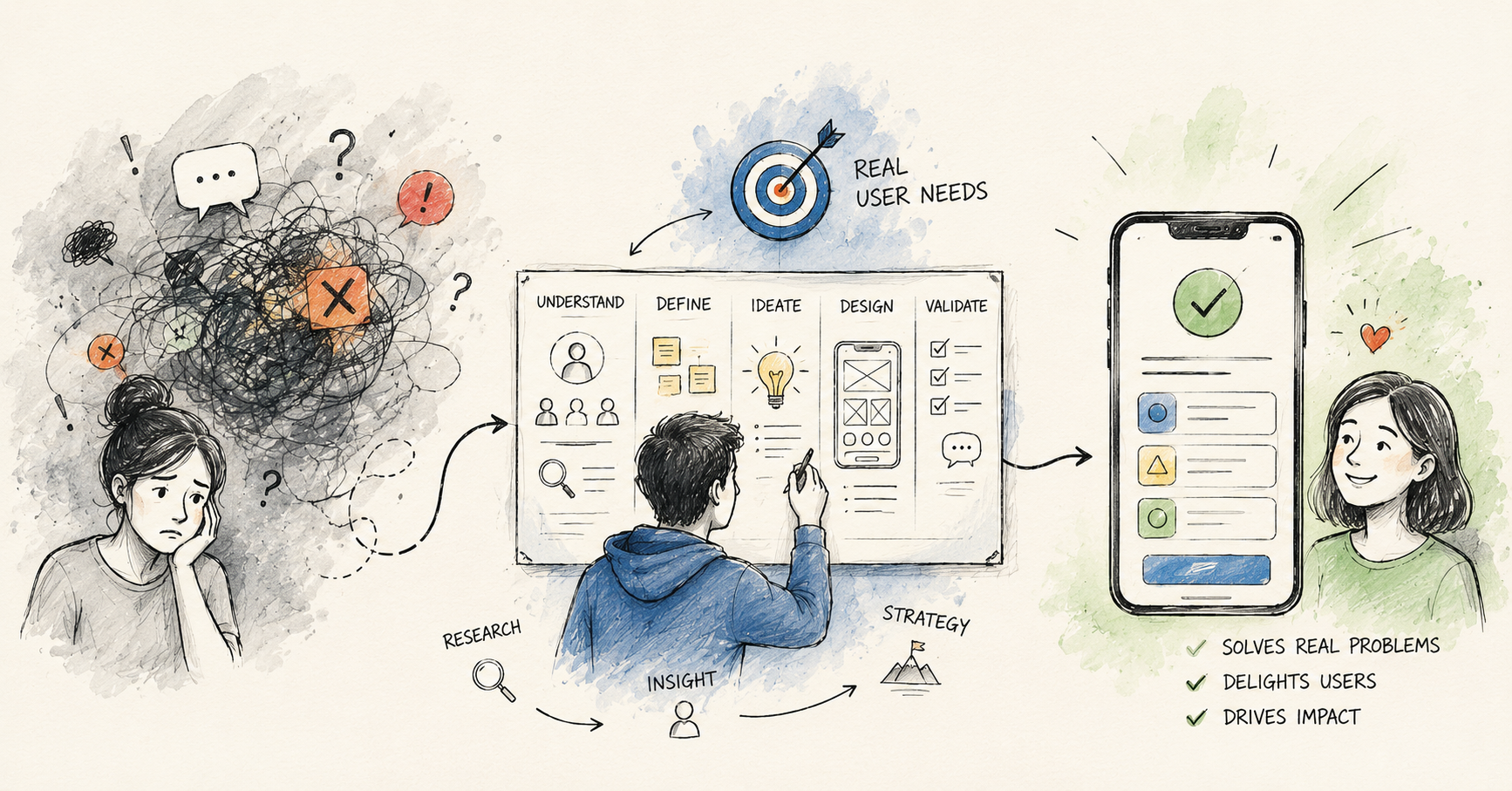
Most digital products fail not because of bad technology, but because of bad assumptions. Teams build features users never asked for, design flows that make sense internally but confuse customers, and launch products without ever validating whether they solve the right problem in the right way.
UX strategy is the antidote to that. It is the discipline of making deliberate, research-backed decisions about what to build, for whom, and why, before the design and development work begins. In this guide, we break down exactly what UX strategy involves, why it is the most valuable investment you can make early in a product’s life, and what a strong UX strategy looks like in practice.
What Is UX Strategy
UX strategy is the high-level plan that aligns user experience goals with business objectives. It combines user research, competitive analysis, and product thinking to define a clear direction for how a product should look, behave, and evolve.
Think of it as the blueprint that guides every design decision that follows. Without it, design becomes subjective. With it, every choice is grounded in evidence.
A well-defined UX strategy answers:
- Who are we designing for, and what do they genuinely need?
- What does success look like for the user and for the business?
- What product experiences already exist, and how do we create something meaningfully better?
- What are the principles that will guide every design decision going forward?
Why UX Strategy Is Not the Same as UX Design
This is one of the most common points of confusion in the product world. UX design is the craft of creating interfaces and interactions. UX strategy is the thinking that determines what those interfaces and interactions should accomplish.
You can have excellent UX design built on a weak strategy, and the product will still underperform. You might have beautifully designed screens that guide users through a flow nobody actually wants. The screens look great, the interactions are smooth, but the product does not solve a real problem, so it does not grow.
UX strategy ensures that the design work is pointed in the right direction from day one.
The Core Components of a Strong UX Strategy
1. User Research
User research is the backbone of any UX strategy. It involves gathering qualitative and quantitative data about your target users to understand their behaviors, goals, frustrations, and mental models.
Common user research methods include:
- In-depth user interviews
- Surveys and questionnaires
- Usability testing on existing products
- Contextual inquiry (observing users in their natural environment)
- Behavioral analytics from existing platforms
The output of user research is a clear, evidence-based picture of who your user is and what they actually need from your product.
2. User Personas
Based on research, we build user personas: detailed, semi-fictional profiles that represent distinct segments of your target audience. Each persona includes demographic information, goals, pain points, behaviors, and motivations.
Personas serve as a reference point throughout the entire product design process. When a design decision comes up, the question becomes: “What would this persona do here?” rather than “What do we think users would do?”
3. Competitive Analysis
A strong UX strategy includes a thorough look at the competitive landscape. This means analyzing direct competitors, indirect competitors, and even products from different industries that share user experience similarities.
Competitive analysis helps identify:
- What design patterns users are already familiar with
- Where competitors are creating friction (your opportunity)
- Where the bar has been set for user experience in your category
- White spaces that your product can own
4. User Journey Mapping
User journey mapping is the process of visualizing every step a user takes when interacting with your product, from first awareness through to repeated use. Each step is mapped against what the user is thinking, feeling, and doing at that moment.
Journey maps expose the moments of friction, confusion, and drop-off that are invisible when you are only looking at screens in isolation. They are one of the most powerful tools for identifying exactly where and why users are leaving.
5. Information Architecture
Information architecture (IA) defines how your product’s content, features, and navigation are organized and structured. Good IA means users can always find what they are looking for quickly and without effort.
Poor IA is one of the leading causes of user frustration and drop-off. When users cannot find what they need, they do not call your support team. They leave.
6. Design Principles
Design principles are a set of guiding statements that define how the product should behave and feel. They act as a decision-making framework for every designer, developer, and product manager working on the product.
Examples of strong design principles:
- Clarity over cleverness: Every interaction should be immediately understandable
- Progress over perfection: Show users where they are and where they are going
- Earn trust at every step: Never ask for more than is needed at any given moment
UX Strategy in Action: A Real-World Example
Imagine a fintech startup building a personal budgeting app. Without a UX strategy, they might design the app based on what they personally find useful, or copy features from existing apps without understanding why those features exist.
With a UX strategy, the process looks like this:
1: User research reveals that the primary pain point is not tracking spending (which most apps focus on) but understanding where money is silently leaking each month.
2: Personas show that the core user is a 28 to 35-year-old urban professional who checks their phone frequently but has limited patience for data entry.
3: Competitive analysis reveals that existing apps are data-heavy and require significant manual input, creating drop-off after week one.
4: The strategy defines a principle: “Insight without effort.” The product should surface money insights automatically, requiring minimal input from the user.
The information architecture and user flows are designed around this principle, putting automated insights front and center rather than manual transaction logs.
The result is a product that solves a real, validated problem in a way that fits the user’s actual behavior. That is what a UX strategy enables.
When Should You Develop a UX Strategy
The best time to develop a UX strategy is before design begins. But it is never too late to build one.
You need a UX strategy if:
- You are starting a new digital product or app
- Your existing product has poor engagement or high churn
- You are planning a significant redesign or new feature set
- Your team is making design decisions based on opinion rather than data
- You are preparing your product for investment and need to demonstrate user validation
How Long Does a UX Strategy Take
A focused UX strategy engagement typically takes two to six weeks, depending on the complexity of the product and the depth of research required. This includes user research, persona development, journey mapping, competitive analysis, IA definition, and the documentation of design principles.
This investment at the start of a project routinely saves months of rework during development and prevents the far greater cost of launching a product that users do not engage with.
CONCLUSION
UX strategy is not a phase you skip to save time. It is the work that makes every other phase faster, smarter, and more effective. It transforms product design from an exercise in aesthetics into a process of problem-solving grounded in real user understanding.
If your digital product needs a strategic foundation that drives real results, our UX strategy services are built for exactly that.