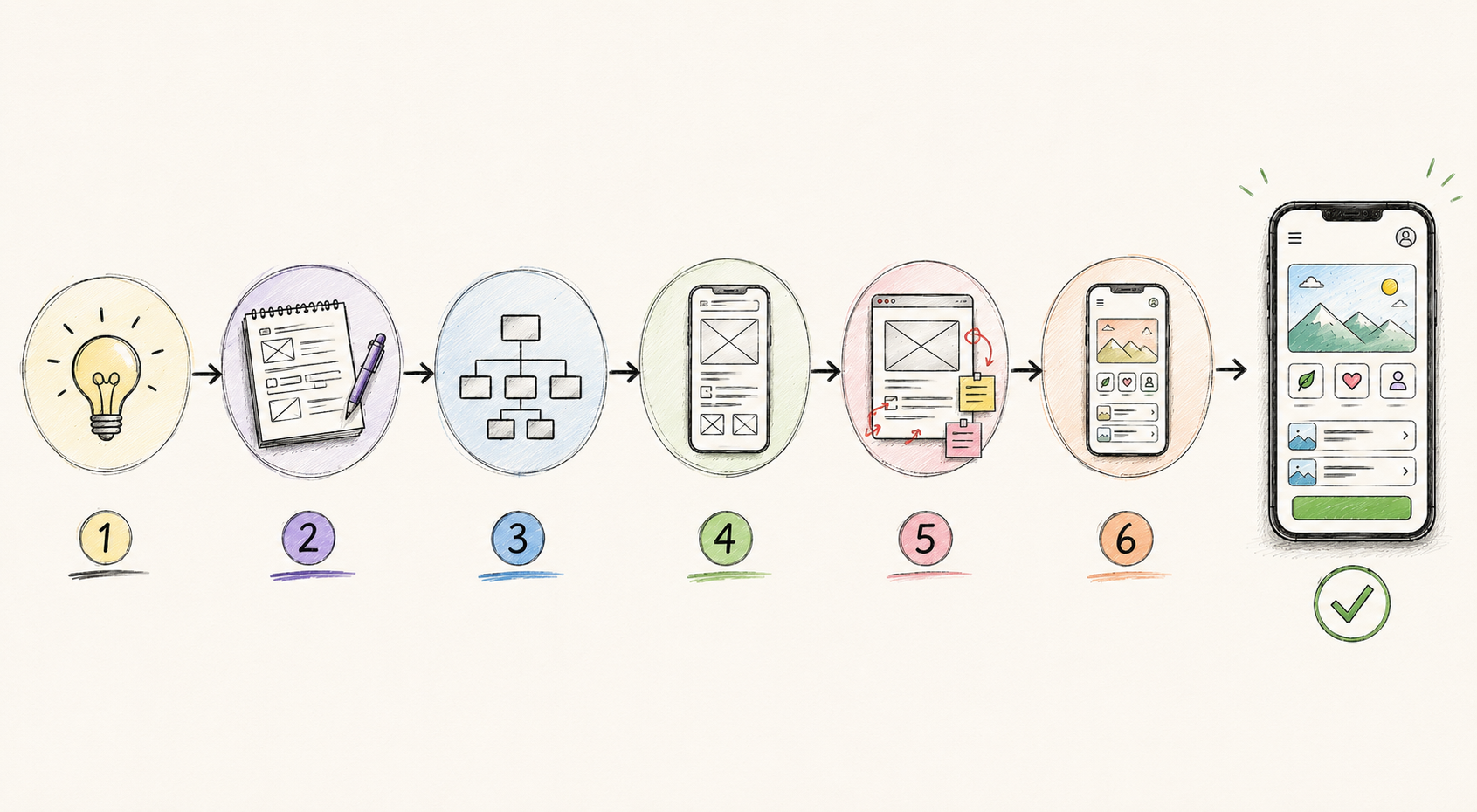
A great digital product does not happen by accident. Behind every app or platform that feels effortless to use is a deliberate, structured design process that transformed a raw idea into a tested, refined, and developer-ready experience.
But what does that process actually look like? What happens between the moment a client walks in with an idea and the moment a finished product launches? For most businesses, the product design process is a black box. They know something important happens, but the specifics are unclear.
This post pulls back the curtain. Here is a transparent, step-by-step walkthrough of the product design process we follow, why each stage exists, and what comes out of it.
Stage 1 — Discovery and Definition
Every product design engagement starts with a deep discovery phase. Before we design anything, we need to understand the full context of what we are building and why.
What Happens in Discovery
Business objective alignment: We start by understanding what success looks like for your business. What problem does this product solve? What does growth look like in year one? Who are the key competitors?
Stakeholder interviews: We conduct structured interviews with your founders, product managers, and any other key stakeholders to surface assumptions, constraints, and priorities.
Existing data review: If you have an existing product or website, we review your analytics, user feedback, support tickets, and any previous research. This baseline understanding is invaluable.
Constraints mapping: We identify technical, budgetary, timeline, and regulatory constraints that will shape the design process.
What Comes Out of Discovery
- A clear product brief documenting goals, users, scope, and constraints
- A shared understanding across all stakeholders of what is being built and why
- A prioritized list of questions the design process needs to answer
Stage 2 — User Research
With the business context established, we shift focus entirely to the user. The goal of user research is to replace assumptions with evidence.
What Happens in User Research
User interviews: We conduct one-on-one interviews with five to ten people who represent your target audience. These conversations reveal motivations, pain points, mental models, and language patterns that directly inform design decisions.
Surveys: For broader quantitative insights, we use structured surveys to gather data from a larger sample of target users.
Competitive UX analysis: We analyze competing products from the user’s perspective, identifying what they do well, where they create friction, and what patterns users are already familiar with.
Behavioral data analysis: Where available, we analyze behavioral analytics to understand how users currently interact with your product or category.
What Comes Out of User Research
- User personas: Detailed profiles of two to four distinct user types based on research findings
- Validated pain points and jobs to be done
- Competitive experience benchmarking
- A research synthesis document that becomes the reference point for all design decisions
Stage 3 — UX Strategy and Information Architecture
With research complete, we define the strategic direction for the product and establish its structural foundation.
What Happens in This Stage
UX strategy definition: We define the product’s design principles, experience goals, and the key metrics that will determine whether the design is successful.
User journey mapping: We map the complete journey a user takes with the product, from discovery through to regular use. This makes drop-off points and opportunity moments visible.
Information architecture design: We define how the product is structured: what screens exist, how they relate to each other, how navigation works, and how content is organized.
Feature prioritization: Based on research and strategy, we prioritize features for the initial product, separating must-haves from nice-to-haves.
What Comes Out of This Stage
- A documented UX strategy including principles and success metrics
- User journey maps for each key persona
- A site map or screen map defining the complete structure of the product
- A feature priority matrix
Stage 4 — Wireframing
With the structure defined, we start designing screens, beginning with low-fidelity wireframes.
What Happens in Wireframing
We create black and white, low-detail layouts of every key screen in the product. Wireframes communicate structure, hierarchy, and flow without the distraction of visual design.
At this stage, we typically explore two to three layout directions for key screens before aligning on a single direction to develop further. Speed and iteration are the priorities. The goal is to get the structure right before investing in visual design.
What Comes Out of Wireframing
- Low-fidelity wireframes for all primary screens
- Annotated designs that explain the intent of each layout decision
- A wireframe flow that connects all screens into a coherent, clickable structure
Stage 5 — Prototyping and User Testing
With wireframes approved, we build an interactive prototype and put it in front of real users.
What Happens in Prototyping
We connect the wireframes into a clickable prototype using Figma. The prototype simulates the full user experience of the product, allowing real users to navigate through flows and complete tasks as they would in the final product.
We then conduct usability testing sessions with five to ten users from the target audience. Sessions are structured around specific tasks, and we observe how users interact with the prototype without guiding them. We capture moments of hesitation, confusion, and error.
What Comes Out of Prototyping and Testing
- A tested, iterated interactive prototype
- A usability testing report documenting findings and prioritized recommendations
- Clear evidence of which design decisions are working and which need refinement
Stage 6 — Visual Design
With the UX validated through testing, we apply the full visual language to the product.
What Happens in Visual Design
We develop the product’s visual identity as expressed through the interface: typography, color system, iconography, component design, spacing, and imagery direction.
This stage produces a high-fidelity prototype that is visually complete and represents the final product as closely as possible. We also build a design system at this stage, a library of reusable components that ensures visual consistency across every screen and speeds up development.
What Comes Out of Visual Design
- High-fidelity screens for all product views
- A complete design system and component library
- An updated interactive prototype at full visual fidelity
- Brand and style guidelines specific to the product interface
Stage 7 — Development Handoff
The final design stage is preparing everything for the development team.
What Happens in Handoff
We prepare a comprehensive handoff package that gives developers everything they need to build the product accurately. This includes annotated designs with spacing, typography, and color specifications, an assets package with all icons, illustrations, and imagery, interaction specification documents describing animations and state changes, and a walkthrough session with the development team.
What Comes Out of Handoff
- A complete, developer-ready design package
- Reduced ambiguity and fewer revision cycles during development
- A shared reference point for QA and testing
Stage 8 — QA Review and Post-Launch Design Support
Our involvement does not end at handoff. Once development begins, we conduct design QA reviews to ensure the built product matches the design intent. After launch, we support ongoing design iteration based on real user behavior data.
This is where the UX strategy defined at the start pays off: with clearly defined success metrics in place, we can objectively evaluate the launched product and make data-driven decisions about what to improve next.
CONCLUSION
A rigorous product design process is what separates digital products that grow from ones that stagnate. Every stage exists for a reason: to reduce uncertainty, validate decisions, and ensure that when development begins, the team is building the right product in the right way for the right users.
If you are ready to take your product through a process built for results, we would love to work with you.