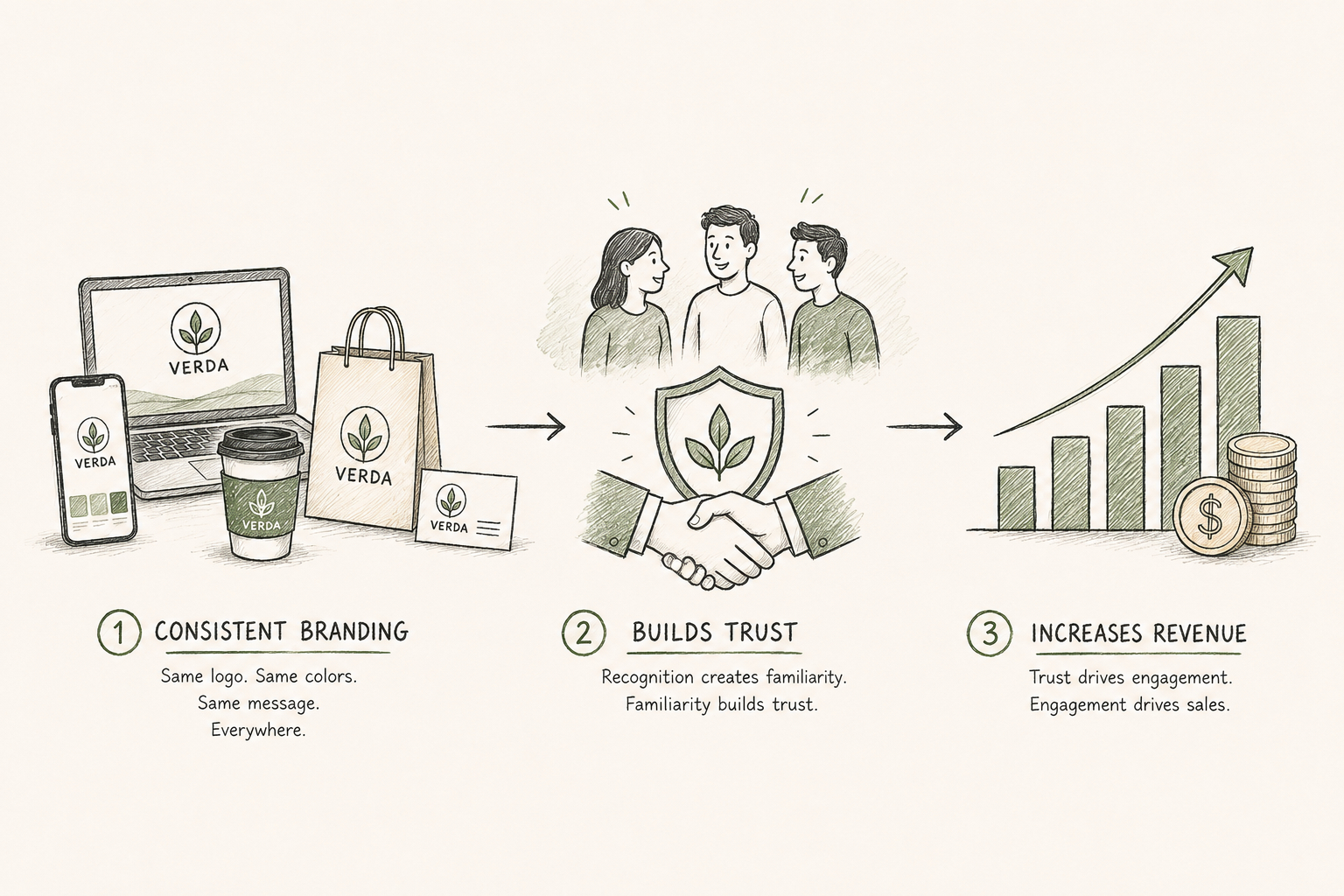
There is a reason the world’s most successful brands feel the same whether you encounter them on a billboard, a social media post, a product package, or a customer service call. That consistency is not accidental. It is the result of deliberate, disciplined brand management that ensures every customer touchpoint reinforces the same identity, the same values, and the same promise.
Consistent branding is one of the most underestimated growth levers available to businesses of any size. Research by Lucidpress found that consistent brand presentation across all platforms increases revenue by up to 23%. Yet most businesses, particularly growing ones, struggle to maintain consistency as their team expands, their channels multiply, and their content output accelerates.
This blog explains exactly what brand consistency means, why it drives trust and revenue, what inconsistency costs you, and how to build the systems that keep your brand coherent as your business grows.
What Does Consistent Branding Actually Mean
Brand consistency means that every customer touchpoint, whether it is your website, your Instagram feed, your email newsletters, your sales presentations, your packaging, or your customer service interactions, feels like it comes from the same brand.
This consistency operates on two levels.
Visual consistency means using the same logo, the same colors, the same typography, and the same imagery style across every platform and every format. It means a customer who sees your Instagram post and then visits your website feels the same visual language in both places.
Verbal consistency means communicating with the same tone, the same personality, and the same core messages across every piece of content and every customer interaction. It means your social media captions sound like the same brand that wrote your website copy.
When both visual and verbal consistency are in place, the brand feels cohesive, professional, and trustworthy. When either is missing, the brand feels scattered, amateur, and unreliable, even if the actual product or service is excellent.
Why Consistent Branding Builds Trust
Familiarity Creates Comfort
Human psychology is wired to trust the familiar. When customers encounter your brand repeatedly and it looks and sounds the same every time, familiarity builds. That familiarity creates a sense of comfort and reliability that is a direct precursor to trust.
Brands that look different every time a customer encounters them feel unpredictable. Unpredictability is the enemy of trust.
Consistency Signals Professionalism and Reliability
When a brand is visually and verbally consistent, it signals that the business behind it is organized, professional, and attentive to detail. These signals matter enormously to customers making purchasing decisions, particularly for higher-value products and services.
Conversely, a brand that looks inconsistent signals disorganization. If a business cannot manage the consistency of its own identity, customers reasonably wonder whether it can manage the consistency of its product quality or service delivery.
Consistency Reinforces Your Brand Promise
Every brand makes a promise to its customers, whether explicit or implicit. A luxury brand promises quality and exclusivity. A challenger brand promises disruption and value. A specialist brand promises expertise and focus.
Consistent branding reinforces that promise at every touchpoint. Every time a customer encounters the brand and it looks, sounds, and behaves in alignment with the promise, their confidence in that promise grows. Every inconsistency introduces doubt.
Consistency Builds Brand Recall
Memory is built through repetition. The more consistently a brand presents its visual and verbal identity, the more firmly those elements are encoded in customers’ memories. Over time, consistent brands earn the kind of instant recognition that makes marketing significantly more effective and efficient.
When a customer sees your brand color or hears your brand voice and immediately knows it is you, you have earned a level of mental availability that your competitors have to work harder to achieve.
The Business Case for Brand Consistency
The link between brand consistency and business performance is well established.
Revenue impact: Research by Lucidpress found that consistent brand presentation across all platforms increases revenue by up to 23%.
Customer loyalty: Consistent brands are easier for customers to trust, and trusted brands generate repeat business. Acquiring a new customer costs five to seven times more than retaining an existing one. Anything that improves retention has a direct and significant impact on profitability.
Marketing efficiency: When your brand is visually and verbally consistent, every marketing asset you produce builds on the equity of every asset that came before it. Inconsistent brands have to re-establish themselves at every touchpoint, making every marketing effort less efficient.
Sales conversion: Consistent brands convert at higher rates because they reduce the cognitive friction of the purchase decision. When everything a customer has seen from your brand is consistent and professional, the decision to buy feels lower risk.
Premium pricing power: Consistent, well-positioned brands can command premium pricing because they are perceived as more trustworthy and reliable. Inconsistent brands compete on price because they lack the brand equity to justify a premium.
What Brand Inconsistency Actually Costs You
Many businesses underestimate the cost of brand inconsistency because it is rarely visible as a single line item. Instead, it shows up as:
Lower conversion rates across marketing channels because different touchpoints feel disconnected and unprofessional.
Higher customer acquisition costs because inconsistent brands do not build the recognition and recall that makes marketing compound over time.
Weaker customer loyalty because customers who encounter an inconsistent brand experience feel less confident in the brand’s reliability.
Internal inefficiency because teams without clear brand guidelines waste time recreating assets, making inconsistent decisions, and producing materials that do not align with brand standards.
Lost deals in competitive situations where a more polished, consistent competitor wins on perception even when the actual offer is similar.
The Most Common Causes of Brand Inconsistency
Understanding why inconsistency happens is the first step to preventing it.
No brand guidelines: Without a documented visual and verbal identity system, every person who produces brand materials makes their own decisions. The result is inevitably inconsistent.
Multiple people producing content without alignment: As teams grow, more people contribute to brand communications. Without shared guidelines and quality control, individual interpretations diverge.
Using the wrong files or assets: Teams working from outdated logo files, incorrect color codes, or unapproved templates produce materials that do not match the brand standard.
No central asset library: When brand assets are scattered across different drives, email threads, and personal computers, people use whatever they can find rather than the correct, approved versions.
Adapting the brand for different channels without rules: Social media, email, print, and out-of-home all have different format requirements. Adapting the brand for these formats without clear rules about how to do so leads to inconsistency.
How to Build and Maintain Brand Consistency
Create Comprehensive Brand Guidelines
Brand guidelines are the single most important tool for maintaining consistency. A strong guidelines document covers logo usage rules, color specifications, typography hierarchy, imagery direction, tone of voice principles, and examples of correct and incorrect brand application.
Guidelines should be detailed enough to be unambiguous but practical enough to actually be used. A document that sits in a folder and is never consulted is not serving its purpose.
Build a Centralized Brand Asset Library
Create a single, centralized location where all brand assets live: logos in all formats, approved color palettes, font files, approved photography, templates for common document types. Make this library easily accessible to everyone who produces brand materials.
Create Templates for Repeat Formats
For content formats that are produced frequently, such as social media posts, presentations, email headers, and document covers, create pre-designed templates that apply the brand guidelines automatically. Templates dramatically reduce the time required to produce on-brand content and eliminate the inconsistency that comes from starting from scratch each time.
Conduct Regular Brand Audits
Periodically review a cross-section of brand materials across all channels and evaluate them against the brand guidelines. A brand audit reveals where inconsistencies are creeping in and enables corrective action before they become entrenched.
Educate Everyone Who Touches the Brand
Brand consistency is a team responsibility, not just a design team responsibility. Everyone who writes copy, designs materials, responds to customer emails, or represents the brand in any way should understand the brand guidelines and why they matter.
CONCLUSION
Consistent branding is not a nice-to-have. It is a growth strategy. It builds the recognition, trust, and loyalty that make marketing more effective, sales easier, and customers more likely to return and refer.
The brands that achieve lasting success are not always the ones with the biggest budgets or the most talented teams. They are the ones that show up consistently, look the same, sound the same, and deliver on the same promise every single time.